Thursday, November 5, 2009

Poland - Extensive Interview with Michael Traison


Michael Traison (c) looks on at ceremony presenting awards to non-Jewish Poles who preserve Jewish heritage, July 2009. Photo (c) Ruth Ellen Gruber


By Ruth Ellen Gruber

My friend Michael Traison is the subject of a lengthy and detailed profile in the Chicago Jewish News. The article, by Paul Dubkin Yearwood, includes a long interview with Michael -- and discusses the important work he has been doing in Poland -- some of which I have written about here, including the annual awards to non-Jewish Poles who preserve and promote Jewish heritage and the Shabbaton weekends in disused synagogues he sponsors.

Michael and I met in January 1995, at ceremonies marking the 50th anniversary of the liberation of Auschwitz. We bonded instantly over our mutual feeling that Jewish experience in Poland should not just be defined in terms of death.

I'm delighted to see him and his work get this recognition.

"When you mention Poland, most Jews feel it is a forbidden land, nothing but a cemetery," he says. "People have created the idea that Poles were responsible for World War II and the Holocaust."

Why do so many Jews in some ways "have more powerful, passionate feelings about Poland than about Germany?" he asks. "You have the strongest feelings about those to whom you have the closest ties. When a family member betrays you, it is worse than when a stranger does."


Traison wanted to find answers for himself on these matters, and for that, he had to visit Poland. He flew to Warsaw, alone, intending to stay for four days, then go on to Israel.
"I couldn't speak a word of Polish and few Polish people knew how to speak English," he says. "I was basically on my own, communicating by body language, isolated, yet knowing the streets, the places, almost like I had been there before."


The connection to the land was instantaneous. "I feel like the month I was born, October 1946, there must have still been smoke from the chimneys of the camps, and I must have inhaled the souls of some of our people," he says.


On that first visit, "for whatever reason, I had positive experiences," he says. "I encountered Poles and they saw me walking, wearing a kippah. People would offer to show me the local cemeteries or synagogues. They viewed it as part of their own Polish history and culture." He also met others "who were afraid I was coming to take back my property. There was a certain amount of fear and anxiety, but many people were very hospitable."
That visit was "a life-changing experience" for Traison, he says. Soon he found himself visiting there four times a year, then every month. Eventually he combined the journeys with his law practice - he is a principal in a large Chicago firm, Miller, Canfield, Paddock and Stone, that has three offices in Poland, and practices commercial law.


[...] his trips to Poland grew more frequent and his involvement in projects relating to the Holocaust and the country's Jewish population more intensive. (He notes that a Google search of his name and "Poland" yields dozens of entries.) Today he spends about 25 percent of his time there - about a week out of every month - and is now engaged in 75 different projects.
Read full article

Sweden: A Mythical Lesbian City


There is a wide range of reasons to visit Sweden: beautiful nature, friendly people, mooses and other wild game... the list is unending. But there is another, and a very curious one, reason to visit this Viking country: a hidden city of Swedish Amazones!

 If you are a tourist planning to visit Sweden, you shoud be aware of this story. There have been rumors of a city dwelled by 25,00 lesbians somewhere in the northern parts of the country. The Swedish tourist authorities (not to mention the Internet queries) are being swarmed with questions about this intriguing topic.


Source: anthromodernity.com 


The story has been spreading in Asia - in Chinese media, for example, you can find some information about a city called "Chako Paul City", supposedly founded in 1820 in northern Sweden by a wealthy man-hating widow who banned all males from entering the settlement. After some time, all of the women were to become lesbian, “because they could not suppress their sexual needs,” reports China’s Harbin News service. The city can be recognized by an medieval castle built there to protect the city, as well as tall, blonde and strong women guarding the premises.


 Needless to say, the Swedish tourist authorities are as surprised as the rest of the nation. Claes Bertilson, the spokesman for SALAR, says: “I've no idea where this came from, but it's not true. At 25,000 residents, the town would be one of the largest in northern Sweden, and I find it hard to believe that you could keep something like that a secret for more than 150 years.”


 Mountains in Lappland, Sweden.   
(Wikimedia Commons/Alexandre Buisse (Nattfodd)/"GNU Free Documentation License")

Although Per Wilhelmsson of the tourist office in Umea in northern Sweden said he had never heard of Chako Paul City, he did confirm that tourism in the area is bustling.
“Our tourism industry is doing quite well, among the best in northern Sweden,” he said.

He also confirmed that no “women-only” city existed in northern Sweden, but the story reminded him of an 30-year old stunt carried out by Pajala, a northern Swedish town suffering from a different problem:
“They arranged for bus loads of women to come up to this town because there weren't enough of them,” he explained.

When asked what else might be drawing tourists to northern Sweden besides the chance to visit an isolated town filled with sexually frustrated females, Wilhelmsson had a theory of his own.

“It’s hard to say for sure, but I think part of it might be increased interest following our designation as Europe’s Cultural Capital for 2014,” he said.


Source:   
http://www.newser.com/

http://www.thelocal.se/22476/20091005/
Bookmark and Share

Wednesday, November 4, 2009

Romania -- More on Gura Humorului


Photo (c) Ruth Ellen Gruber

By Ruth Ellen Gruber

A few weeks ago, I posted a video that I took of the wonderful and well maintained Jewish cemetery in Gura Humorului, Romania. I was there to document that tombstones of women for my project (Candle)sticks on Stone: Representing the Woman in Jewish Tombstone Art.

I forgot to include the link to the excellent and informative web site about Gura Humorului, which include a map and index of the cemetery. You can find that web site by clicking RIGHT HERE.
In 1857 Gura Humorului had a Jewish population of 190 souls. In that year also the Jewish cemetery was established. That cemetery was active until 1920. In 1920 the "New" cemetery was established right near the "Old" one, and it is still open today. This cemetery (the old and the new) has about 2060 graves. Stones beautifully cared for, many in German. The new part was renovated recently by The Association of Gura - Humora Jewish Community Descendants.

Monday, November 2, 2009

My article on Holocaust memorials


 Budapest -- Holocaust memorial museum and education center. Photo (c) Ruth Ellen Gruber

I have a brief article on Holocaust memorials in post-communist Europe, part of JTA's series related to the 20th anniversary of the fall of communism.


By Ruth Ellen Gruber, Oct. 30, 2009

ROME (JTA) -- Under communism, Jewish suffering in World War II generally was treated as a footnote to the overall losses in what the Soviets called the "Great Patriotic War."

Public monuments existed at some Holocaust sites in Eastern Europe, such as Auschwitz, the Paneriai forest near Vilnius where at least 70,000 Jews were killed, and Babi Yar, where tens of thousands of Jews were killed in ravines outside Kiev. But these usually commemorated generic "victims of fascism" and did not acknowledge the involvement of local collaborators.

Since the fall of communism 20 years ago, however, a host of new Holocaust memorials have gone up in post-communist states while and Communist-era monuments have been revamped by state authorities, local civic groups and Jewish organizations, giving the Jewish tragedy of World War II more prominence.

The new memorials range from simple plaques to modest monuments to huge memorial complexes, such as the monument at the Belzec death camp. A joint project of the Polish government and the American Jewish Committee, the monument was inaugurated in 2004 by the Polish president.
Some new sites, such as Belzec and the state-run Holocaust memorial center in Budapest, which also opened in 2004, include museums or educational facilities.

In other cases, including at Babi Yar and Paneriai, new inscriptions or components have been added to provide more accurate information and context in order for the memorial site to teach and inform as well as commemorate.

This can become contentious if, for example, the new inscriptions make reference to local collaboration in the killing of Jews.

"After the problem of funding, the hardest part of getting monuments and memorials erected has not been getting some kind of general consent, but it has been working out the specifics of the design and especially the language on the inscription," said the president of the International Survey of Jewish Monuments, Samuel Gruber, who has written about Holocaust memory and consulted on Holocaust monument projects.

"Most older memorials have been very general in their language, so much so that it is often hard to figure out what events are being commemorated, and rarely can one learn about who did what to whom and when,” he said.

This remains a concern, even with monuments whose positioning and design make them prominent. Some memorials form a striking symbolic presence, but provide little or no information as to what they commemorate. Visitors are presumed to know already what they represent.

In the heart of the Slovak capital Bratislava, for example, a chiseled image of a destroyed synagogue now serves as a Holocaust memorial. But other than the word "Remember," no information is provided on how the wartime fascist state collaborated with the Nazis in killing most of Slovakia's 135,000-strong prewar Jewish community.

Likewise, in Sopron, Hungary, a small but powerful sculptural monument depicting empty clothing hung outside the Auschwitz gas chambers stands near an abandoned synagogue. The memorial bears Hebrew lettering and the Sh’ma prayer, but no further information.

"How can one remember what one doesn't know?" Gruber said. "How can one 'not forget' what is never fully discussed or taught?"

On Slovakia’s Holocaust Memorial Day, Sept. 9, Slovak Prime Minister Robert Fico presided over the dedication of a memorial to Slovaks who helped rescue Jews at the time of the anti-Nazi Slovak National Uprising in 1944.

Funded by the Israeli Chamber of Commerce in Slovakia and several private sources, the memorial was built in the town of Zvolen next to the mass gravesite of Jews who were killed by the Nazis. It also includes a digital information point.

"This represents a different way of presenting Slovak national history that is at the same time a rejection of the [Nazi-allied] Slovak national puppet state of Josef Tiso," said Rabbi Andrew Baker, the American Jewish Committee's director of international Jewish affairs who has advised on Holocaust memorial projects in several countries. "Fico deserves credit for doing this, and he also speaks emotionally about the importance of Holocaust education in his country."

Though flawed at times, the memorials serve an important purpose.

"Memorials have a permanent presence," said Warren Miller, chairman of the U.S. Commission for the Preservation of America's Heritage Abroad, which has been involved in Holocaust memorial projects in Latvia, Romania, the former East Germany and other countries. "Going to a powerful memorial will help people want to learn more."

Lviv -- Interactive Map. Are they working together?


 Me in L'viv... Photo (c) Ruth Ellen Gruber

By Ruth Ellen Gruber

I was very impressed last year in L'viv when I found out about the L'viv interactive street map on the web site of the L'viv Center for Urban History of East-Central Europe. The Center, based in the heart of L'viv, is compiling an ever-expanding, interactive data base of streets, buildings, institutions, etc, that can be accessed online. It's a great resource.

Today on the Tracing the Tribe blog, I found out that another project, which sounds very similar, has been launched by a group called Gesher Galicia and begun earlier this year by Dick Koops, a Dutch-born teacher. It is called the L'viv House and Street Photography Project.  There is no indication as to whether there is any coordination or collaboration between these two projects. It's a pity if not. (The wheel has already been invented.....)

Budapest -- New Book on Dohany St. synagogue


 Tourists outside the Dohany St. synagogue during the summer Jewish culture festival, Sept. 2009. Photo (c) Ruth Ellen Gruber


By Ruth Ellen Gruber

The second major book in less than two years has come out in Hungary on the Dohany St. synagogue -- the biggest synagogue in Europe and a major Budapest landmark, which was inaugurated just 150 years ago.

This book, titled simply "The Dohany Street Synagogue," is by the Hungarian-born American photographer Laszlo Regos, and it was published by the Hungarian publisher Alexandra to coincide with events marking the synagogue's anniversary in September. I have not seen the book yet, but Regos posted a video preview on YouTube.

Regos, who specializes in architectural photography, said that what sets his book apart from that published last year by the Budapest-based architectural historian Rudolf Klein ("The Great Synagogue of Budapest," published by the Budapest house, Terc) is the emotional aspect. Klein, he said, "put his talent as a photographer and his knowledge as an architect to it -- I gave my soul. It took me eight years to do it, and [I] approached it not just as an architectural photographer."

Regos is an accomplished photographer and clearly passionate about his subject,  and the photos on the video and on his web site are luscious. Again, I haven't seen the book yet (and don't know what text there is to go with the pictures) but one thing does bother me (it bothers me a bit in Klein's book, too, but that book is really text-driven) -- in the images I have seen, the synagogue is presented as empty; gorgeous and beautiful and artistically and architecturally powerful, but empty. People (Jews or not) are literally not in the picture(s). Yet this is one of the synagogues in Europe -- in post-Holocaust, post-communist Europe -- which is, in fact, rarely empty. On major Jewish holidays, it is packed by a congregation that spills out on the forecourt, seeing and being seeing. At other times during the year, it is crawling with tourists who often must line up to gain entry. It is, in short, a living space -- and I hope that this comes through in the book.

In 2004, Regos included photographs of the Dohany St. synagogue in an exhibition on synagogue architecture held in New York called "Palaces of Prayer." Sam Gruber mentioned this exhibit in an article on synagogue photography in The Forward. 

On his web site Regos includes the following as Artist's Statement:
      ...When I was a little boy, my parents took me there for the very first time. I didn't like the place at all.
      It was dark, gloomy; the lingering smell of crumbling plaster and mildew was in the air. I didn't understand why everyone's eyes were filled with tears.
      Later when I understood all too well, I went back whenever I could to say Kaddish for my grandparents. They didn't come back from Auschwitz, along with the other 600 thousand Hungarian Jews who perished during the Holocaust. Challenging the watchful eyes of the ever-present Secret Police, I went there with my family and friends to demonstrate that we belonged there rather than Communist Party meetings.
      The location was Budapest, Hungary. The place, the Dohany Street Synagogue.
      In 1979 I left Hungary seeking political, religious and artistic freedom.
     The next time I saw her was a few years ago. I couldn't believe my eyes! She was gorgeous and probably looked better than when she was born in 1859. Her breathtaking beauty made me fall in love.

 I too remember the Dohany Street synagogue where it was in terrible condition, dark and dank and with its ceiling sagging down over the sanctuary, swathed in plastic sheeting and held up by metal bands. But I also remember it -- even then -- as, at least on the High Holidays, being, despite everything, a place of life, where thousands of people congregated. They were there to make a statement of belonging and identity -- I'll never forget walking in to Yom Kippur services in 1983 and being aghast at the noise of what amounted to a giant schmooze fest under that sagging ceiling.

Sunday, November 1, 2009

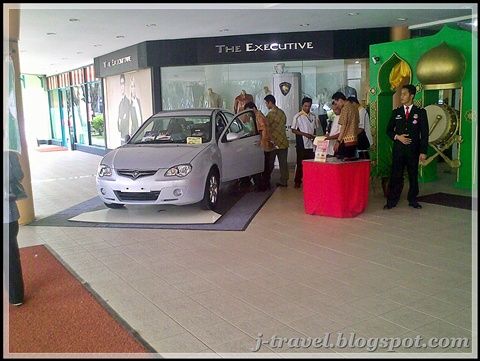
Proton Pesona at Indonesia

Entrance of Mall Lippo Cikarang

Spotted this Proton Pesona Car Promotion at Mall Lippo Cikarang during my second visit to Indonesia. Too bad I forget to look at the selling price...

I wonder how's the sale in Indonesia? Because I still haven't seen One on the road...?

* Photos taken by Nokia E71


MY TRIPS - Home