Monday, February 7, 2011

Middle East -- Synagogue being restored in Damascus

This is off geographical topic, but Bloomberg runs a piece by Massoud A. Derhally noting a project begun in December to restore synagogues in Damascus, Syria.
Albert Cameo, leader of what remains of the Jewish community in Syria, says he’s trying to fulfill an obligation to his religious heritage. The 70-year-old is organizing the restoration of a synagogue called Al-Raqi in the old Jewish quarter of Damascus built during the Ottoman Empire about 400 years ago. The project, which began in December, will be completed this month as part of a plan to restore 10 synagogues with the backing of Syrian President Bashar al-Assad and funding from Syrian Jews.

“Assad sees the rebuilding of Jewish Damascus in the context of preserving the secularism of Syria,” said Josh Landis, director of the Center for Middle East Studies at the University of Oklahoma in Norman. “This is an effort by the regime to show its seriousness and an olive branch to the Jewish community in America, which they have been wooing.”
While Syria is still officially at war with Israel, the country is trying to portray itself as a more tolerant state to help burnish its image internationally. Syria’s 200 Jews are mirroring the actions of their co-religionists in Lebanon, where restoration work began on Beirut’s Maghen Abraham Synagogue in July 2009.

Sunday, February 6, 2011

Candlesticks on Stone -- cross post from the blog

Here's a crosspost from the Candlesticks on Stone blog, considering the question of  when did candlesticks become standard shorthand for denoting a woman.

By Ruth Ellen Gruber

Using candlesticks and candelabra to denote women on tombstones was very common by the mid to late 19th century in the parts of Eastern Europe where I have been focusing this study (northern Romania/Ukraine/Poland and surrounding territory). Indeed, by the late 19th century and early 20th century  this imagery was utilized almost across the board (though birds and flowers were also used), and there was even a variety of  pre-fab templates of fanciful candlesticks, including the style that marked the grave of of my great-great-grandmother, Chaya Dwoira, in the Jewish cemetery in Radauti.
These templates are striking but not great examples of stone-carving — though they derived from the wonderfully sculpted and imaginative stones of the 18th and early 19th centuries (and even in the 17th century). But, when massed together in a crowd, as in Radauti, they are very impressive nonetheless, providing a sense of — well — community or communality, in a way. 100 years and more ago they would have presented even a more striking sight, as they would have been painted bright colors.

Amid the forest of stones, the tomb of Chaya Dvoira (small stone in middle, at left)


Some of these “off the shelf” designs are rooted in the earlier designs of braided candelabra branches and bases that formed the mystical “endless knot” motif. Others attach leaves or sprouts to the candelabras, referring, I imagine to the also mystical “candelabra/menorah as tree of life” motif. Some show hands blessing the flames; others do not. What is interesting, too, is that even stones that looks as if they were carved from identical stencils often differ in subtle ways — note, for example, how the hands are carved differently, and how there are other slight differences in the ornamentation.
Radauti -- tremplate design with candles sprouting leaves

 
                     Radauti -- tremplate designs with candles sprouting leaves

When did the candlesticks imagery become the norm?

In the Old Jewish Cemetery in Siret, Romania,  some of the women’s tombs dating to the very early 19th century bear candle imagery (one has the representation of an antique-looking menorah, others with more fanciful candelabra, in combination with plant motifs).

And some candelabra or candle-bearing stones in Ukraine  date back as early as the mid-18th century. These were documented by the researcher Boris Khaimovich from the Center for Jewish Art, who did his PhD on 17th and 18th century Jewish tombstones in Ukraine. Boris reports that the stone of Esther daughter of Yitzchak, which dates from 1781, is one of the oldest stones in the Jewish cemetery in Kosuv, Ukraine. It shows hands blessing the flames on a seven-branched Menorah and may be one of the earliest stones to bear this image of blessing hands.

Otherwise, the older stones do not seem necessarily to use a specific visual signifier for woman. In the cemetery at Sataniv, for example, the tombstone of Rivkah bat Eliezar Susman, from 1803, bears the mysterious “three hares” carving — three hares joined at the ears an in optical illustion — in a floral medallion flanked by birds and griffons.

Sataniv, Ukraine, 2006 -- woman's tomb with the Three Hares motif

Friday, February 4, 2011

Romania -- Lo-Tishkach publishes a gallery of my photos

By Ruth Ellen Gruber

The Lo-Tishkach web site has published a gallery of my photos of Jewish cemeteries in Romania. You can view it by clicking HERE

Thursday, February 3, 2011

Wall Street On FIRE! @ Wall Street Restaurant & Bar

This party event was held on Nov 2010 at Wall Street Restaurant and Bar. This was also my first time witness the Bar Counter On Fire!

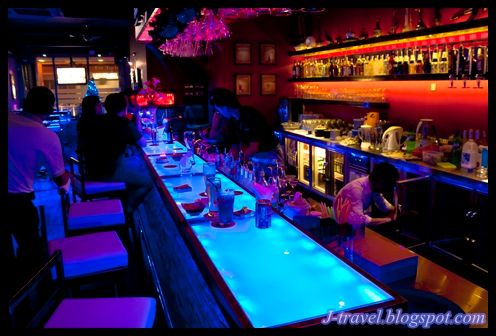
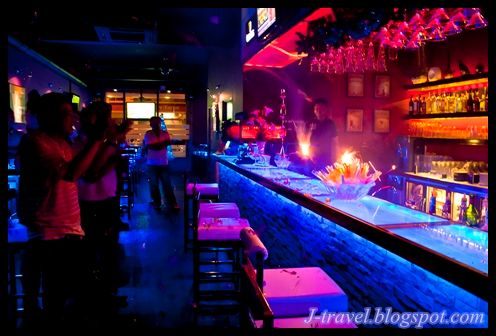
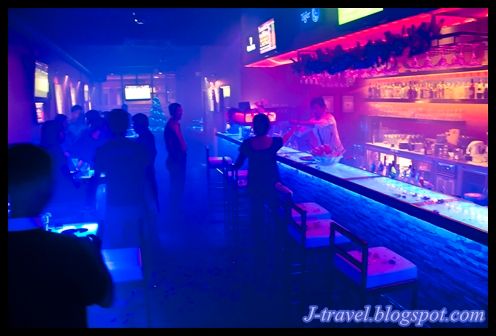
Before the party begin...everything was normal at the bar

I was there quite early that night, and I saw all the preparation of the party. The crowd was ok that time...around 8pm.

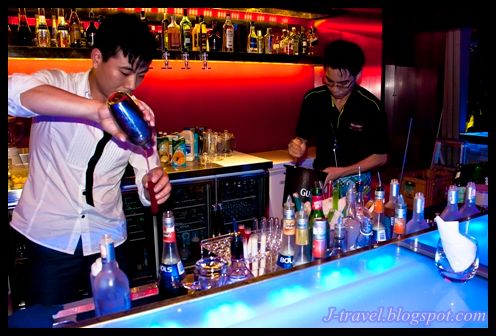
The Bartenders were busy preparing the Cocktail...

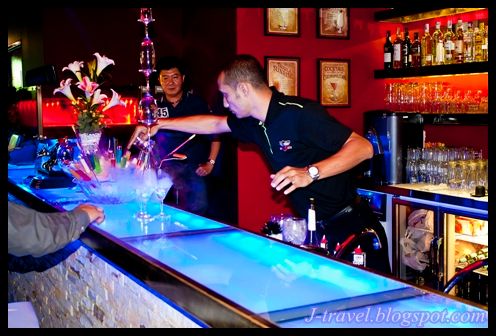
Mr Arab was preparing the performance of the night...

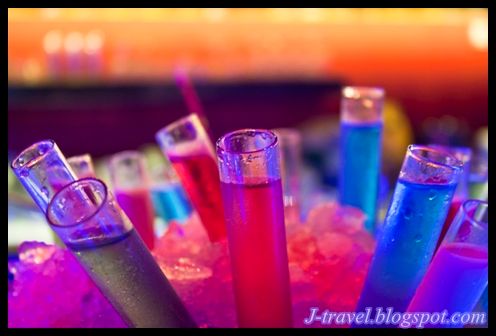
I'm really attracted by this big bowl of Ice with Full of cocktail test tubes! It was colourful!!

The bowl of Ice with test tube Cocktails...


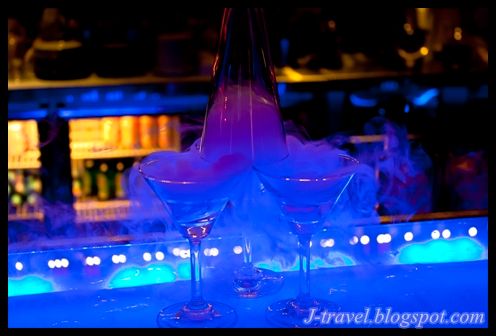
Vincent Yang (Bartender from Shanghai) preparing the dry ice...

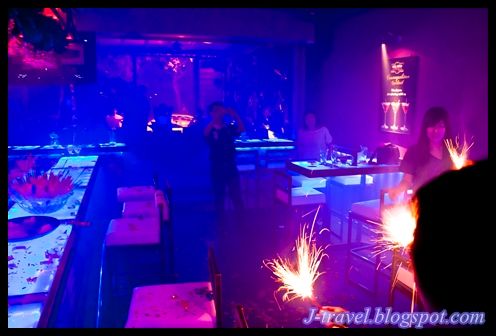
After all the preparation, the customers getting more and more...everyone was anxiously waiting for the Party! Once the clock hit 10pm, the party began! Wall Street On FIRE!

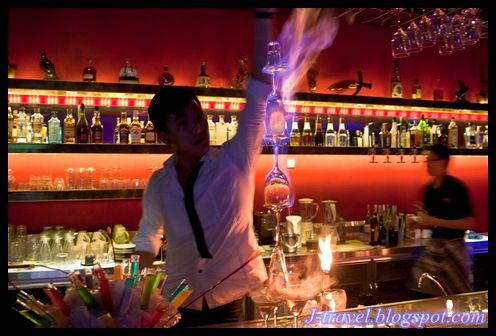
At First, Vincent lighted up one side of the Volcano! The other side was help by the other bartender...

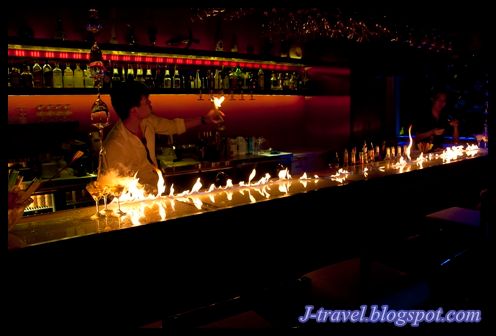
Arab was controlling the Fire which burn through the Bar Counter...!

The Flame of the Volcano!

The Bar was burn up less than 3 second! That time, we Only see Fire on the Bar Counter and Arab & Vincent trying to play some fire tricks on the background!

After the first show, Vincent started the fireworks on THAT bowl of Cocktail! The atmosphere was brought to the highest at that moment! Everyone was excited and voices of congratulation - "Yeah" at every corner!

The bowl of Cocktail test tubes was lighted up with fireworks!


It was BEAUTIFUL!!

Once the fire over, the test tubes were given to all the customers in the bar F.O.C. Well, you can't drink it too fast, because they were Strong & Dangerous! Haha!

Even the fireworks was over from the bar counter, but the customers continue to light up the rest and play with it! WOW! That was really NICE! Everyone Like it very much!

The Bar was FULL of smoke just like we were all at Cameron Highlands! Haha!

Once the ventilation system started, the smoke was gone in second!


That night was actually A Farewell party for the Shanghai Famous Bartender - Mr Vincent Yang. He went back to Shanghai on the next day and I believe MANY women MISS him very much! Haha! Because he made the Perfect Cocktail for us and we miss him too! 

Mr Vincent Yang from Shanghai, China

That was A FANTASTIC Party at Wall Street Restaurant & Bar at Taman Austin Perdana, Johor Bahru.

Related post :-
Wall Street The Restaurant & Bar at Taman Austin Perdana, Johor Bahru

Wednesday, February 2, 2011

Candlesticks on Stone -- Tombstone Typology

By Ruth Ellen Gruber

I have created a rather cool page on my (Candle)sticks on Stone web site, showing some of the many different types and styles of candlesticks used to decorate the tombstones of women in Eastern Europe.
They range from what I would call “classic” Shabbos candles — two matched candles in individual candle-holders — to multi-branched candelabra (including seven-branched menorahs) of various types. Some of them look as if they could have come off of a household’s shelf. Others  look like classic Menorahs of antiquity. Many are elaborately ornamental but still look like physical objects. But others still are intricate figures that weave and twist and entwine the branches of the menorah and/or the base of the menorah into fanciful convoluted forms. And some clearly combine the imagery of the Menorah with that of the Tree of Life — or, perhaps, of death, as in some examples the branches of the menorah may look like snakes.
Some stones bear images of hands blessing the flames.
In their fascinating and wonderful book Traditional Jewish Papercuts: An Inner World of Art and Symbol (Hanover NH, 2002), Joseph and Yehudit Shadur write that the intricately convoluted menorah forms appear almost exclusively  in  two places — in traditional East European Jewish paper cuts (where they are often dominant compositional elements) and on some East European Jewish tombstones. They appear to represent a development of the “endless knot” motif.
The Shadurs write (pp 170-171):
As far as we could ascertain, neither the convoluted menorah configurations nor the endless-knot motif have ever been considered as distinct visual symbols in Jewish iconography. And yet, they are so common and figure so prominently in East-European Jewish papercuts that they can hardly be regarded as mere decorative motifs.
They theorize that
the metamorphosis of the traditional menorah of antiquity and the Middle Ages into the convoluted, endless-knot configurations appearing in the papercuts coincides with the spread and growing popularization of messianic mysticism and the Kabbalah throughout the Jewish communities of Eastern Europe from the early eighteenth century on [.]
In her  book A Tribe of Stones, Jewish Cemeteries in Poland (Warsaw 1994) Monika Krajewska, a post-World War II pioneer in the study of gravestone imagery — who is also an accomplished paper-cut artist, likens the twisted menorahs to the braiding of Challah loaves — and in a way, that would mean that the images denote two of the three “women’s commandments” (lighting the Shabbos candles, “taking Challah” or removing a piece of dough when baking bread, and Niddah, or keeping menstrual purity).

Tuesday, February 1, 2011

The beauty of the Java Sea on the Karimunjawa


Karimun Java language that is derived from the meaning kremun vague or equivocal. Given the name because these islands faintly visible from the island of Java caused situated far enough from the island of Java. To achieve Karimunjawa takes about 4 to 6 hours from the mainland island of Java using Motor Ship Fast from Semarang or Jepara. It feels, fits with his name, because it takes a long time to arrive on the island.

Swimming with sharks in Karimunjawa Kepulauan Karimunjawa a haven from the divers (diver). You can perform various activities in the crystal clear water. Swimming, diving (diving), or snorkeling will be fun.

The beauty of coral reefs and colorful fish in the sea will be an attraction to playing in the water. Sea water in Karimunjawa very clear and transparent, so you can see the sea bottom clearly. For those of you who like fishing, you can also do it on some island in the Karimun.

To visit the islands in Karimun, you can use a fishing boat. The time required is not too old to visit several islands at once because it was not far away. There is also a boat that is equipped with a glass at the bottom of the boat (glass bottom boat) are suitable for you who do not want to dive but want to still be able to see the coral reefs or fish in the sea water.

Karimun Islands
Publications since 2001 has the official name of the National Park Karimunjawa. Karimun National Park consists of a small group of 27 islands with 5 pieces that have been populated island in this archipelago.

The island has a population of Pulau Genting, Kemujan Island, Karimun Island, Mosquito Island, and Island Parang. Most of the island there has a beach with white sand.

The islands are a favorite to be visited by tourists because of its natural beauty including Menjangan Besar Island, Menjangan Small, Pine Small, and Tanjung Gelam. Let's visit the islands one by one!

Menjangan Besar Island On the island there are large captive sharks. You can test your courage by going to their breeding pond and swim with these sharks. No need to fear, because the sharks are here quite tame and friendly with humans.

Small Menjangan Island Small Menjangan worth a visit for the waters around this island there are many small fish are pretty colorful. The island has a beach and a beautiful sea floor with clear water. The island is suitable for you who want to try snorkeling.

Pine Island Pine Island Small and Large On both islands there are many pine trees that may become the basis of the names of the island. Another unique thing is the existence of mainland beaches with white sand that juts into the sea.

Pulau Tanjung Gelam Gelam Cape Island is a beautiful island with white sand and sea water is bluish green.

Accommodation in Karimunjawa
Besides enjoying the beauty of the sea and beaches, you can visit a traditional market or visit the servants who managed to get fish in the fish market.

For accommodations, there are several options you can specify. You can stay at some luxury resort in the small islands or even hotels with cheaper rates. Some locals also rent out his house with a cheaper fare anymore. Or you can try different atmosphere by staying in the House of pumice, which is the inn that is in the water not far from the beach.
 
Transportation to Publications

To go to Publications, you can use some alternative options below:
Fast Ship from Semarang From Hyderabad, you can go to the Publications through the Port of Tanjung Emas using speedboats. Travel from Hyderabad to Publications about 4 hours to 6 hours if the weather is bad.

Ships from Jepara If you choose to go to the Publications of Jepara, you can through the Port of Kartini. You can choose to use speed boats, or also use a slow and cheap ship from Jepara. Travel from Jepara to Publications about 2.5 to 3 hours.

Plane In addition, for those who have enough funds, there is a small plane at Ahmad Yani Airport in Semarang can be hired to Dewa Daru Airport on the island of Kemujan (one of the islands in Karimunjawa). By plane, you can see the beauty of Publications from the top before landing at the airport which is on Karimunjawa. Travel by plane take about 30 minutes.

Enjoy the beauty and feel the serenity of this island will be a pleasant experience. It is advisable to visit this island in March to October, at the time the weather was friendly so you can freely explore and enjoy the islands of Karimun. Enjoy the enchanting beauty of nature in Karimunjawa.

Monday, January 31, 2011

Green Canyon Area Tour at Pangandaran


Green Canyon
Green Canyon tourist attractions located in the village Kertayasa, Ciamis, West Java, about 31 km from Pangandaran. The name was introduced by Green Canyon tourists from France. Greenish color of river water may be the reason this place called Green Canyon. While the previous name, Cukang Taneuh means land bridge because of the bridge with a width of 3 meters and 40 meters long that connects the village with the Village Batukaras Kertayasa.

River Cijulang

The goal is tunnel-like cave which is under the land bridge, known as Green Canyon Cave. To reach the cave, you must use a boat down the river Cijulang known as motorized. The boat was only able to be boarded by 5 passengers. Price rent a boat or motorized Rp 75.000 or $ 8 USD, - per boat. The time required to travel that starts from the pier to the caves Ciseureuh approximately 30 minutes.

On the side of the river flow Cijulang you can enjoy climbing the hill is overgrown with lush green trees and rocks that decorate it. The trip will not be boring because of the beautiful scenery and relaxed enjoying the river flow. Naik ketinting also can create its own uniqueness, especially for kids who love the water.

When almost there, the path will be narrowed so that the boat had to take turns to enter this path. There is also a regulator that provides direction for the driver to drive the boat for an orderly. Near the mouth of the cave, ketinting no longer be able to deliver you and your entourage that is not possible because the path traversed.

Green Canyon Cave
Beautiful views await you after getting off the boat. You can enjoy a solid side cave with stalactite and stalagmite see who was still dripping water. Water continuously issued in the cliff so that this area is called the eternal rain elapsed areas. You can also swim in the cave by using the buoy. You will feel the water was cold and refreshing. More beautiful scenery while watching the waterfall Palatar contained in the Green Canyon Cave. Swimming in cold water while enjoying the high cliffs and see stalactite and stalagmite must have been a special experience that is not forgotten.

Green Canyon or Cukang Taneuh is indeed a beautiful tourist attractions in the area of Pangandaran. But if you intend to visit this place should be visited in the dry season because this season, the river water is green Cijulang tosca. While in the rainy season, when high rainfall, river water will be brown. Also during the rainy season there may be tidal or river water flow of river water that is too heavy, so the place was closed to the public for the safety of visitors.